
The civil engineering courses at BME provide students with a solid understanding of structural engineering, with a particular focus on renewable energy infrastructure such as wind farms, photovoltaic plants, and hydroelectric power stations. The semester builds core competencies in structural design, modelling, and stability, forming the basis for more advanced work throughout the programme.
Students acquire essential numerical analysis skills, including finite element modelling and structural stability analysis. IT skills are integrated into the Numerical Methods course, where students learn to apply programming to real civil engineering problems.
Building physics and technology courses act as a bridge between civil engineering and sustainability. These modules reinforce the interdisciplinary nature of the programme by linking structural design with energy efficiency and sustainable construction practices.
The semester includes a strong project-based learning component. Students work autonomously on civil engineering projects, applying theoretical knowledge to practical scenarios while developing documentation, presentation, and transversal skills.
5 ECTS
56 Contact hours
69 Self-instruction
5 ECTS
56 Contact hours
69 Self-instruction
6 ECTS
56 Contact hours
94 Self-instruction
0 ECTS
0 Contact hours
150 Self-instruction
4 ECTS
42 Contact hours
58 Self-instruction
4 ECTS
42 Contact hours
58 Self-instruction

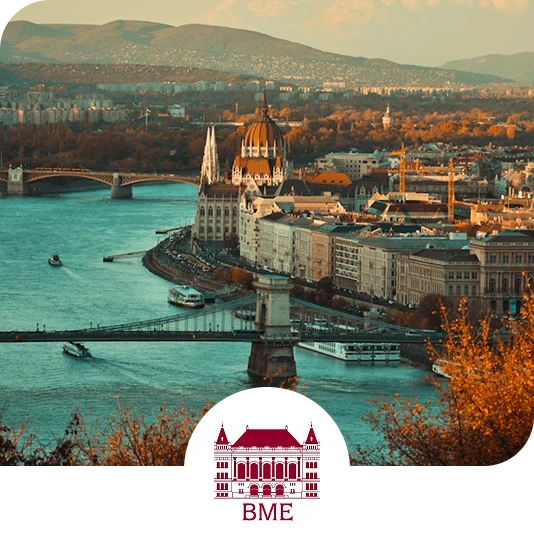
Budapest, the capital of Hungary, is one of the most dynamic and picturesque cities in Central Europe.
Divided by the Danube River into the historic hills of Buda and the lively streets of Pest, the city offers a unique blend of tradition, innovation, and student life.


To provide the best experiences, we use technologies such as cookies to store and/or access device information. Consenting to these technologies allows us to process data such as browsing behavior or unique IDs on this site. Not consenting or withdrawing consent may adversely affect certain features and functions.
Ready to build the future of sustainable engeneering in Europe ? Apply now and experience an inspiring study environment across Europe.